Thursday, August 30, 2012

Northern Queensland Part 3: Giant pythons, baby pheromones, and exotic ice cream

This is the third part in a series on a trip to the Great Barrier Reef and Daintree Rainforest. See part 1 and part 2

In addition to the "discovery" of the Daintree, the 1960s were significant for another reason: aborigines won Australian citizenship and the right to receive the same wages as white people. Previously, they'd been used as unpaid labor on many of the cattle stations in Australia (and they actually weren't considered people, but part of the "Flora and Fauna"). In return for free labor, they were allowed to remain in their ancestral homes. With the right to be paid as equals secured, they were promptly kicked off the land. This happened throughout Australia, but the impact was particularly felt in the forest, which didn't become protected park land until 1981.

One of the consequences of removing the human factor from the Daintree -- a presence that had been around for tens of thousands of years -- was that the animal populations fell out of balance. Aborigines had hunted and eaten pythons. Without them keeping pythons in check, the snakes had flourished as the apex predator and were eating their way through the mammal and bird species. The Bennet's Tree Kangaroo, a small kangaroo that lives in trees, was particularly hard to find now, Neil said.
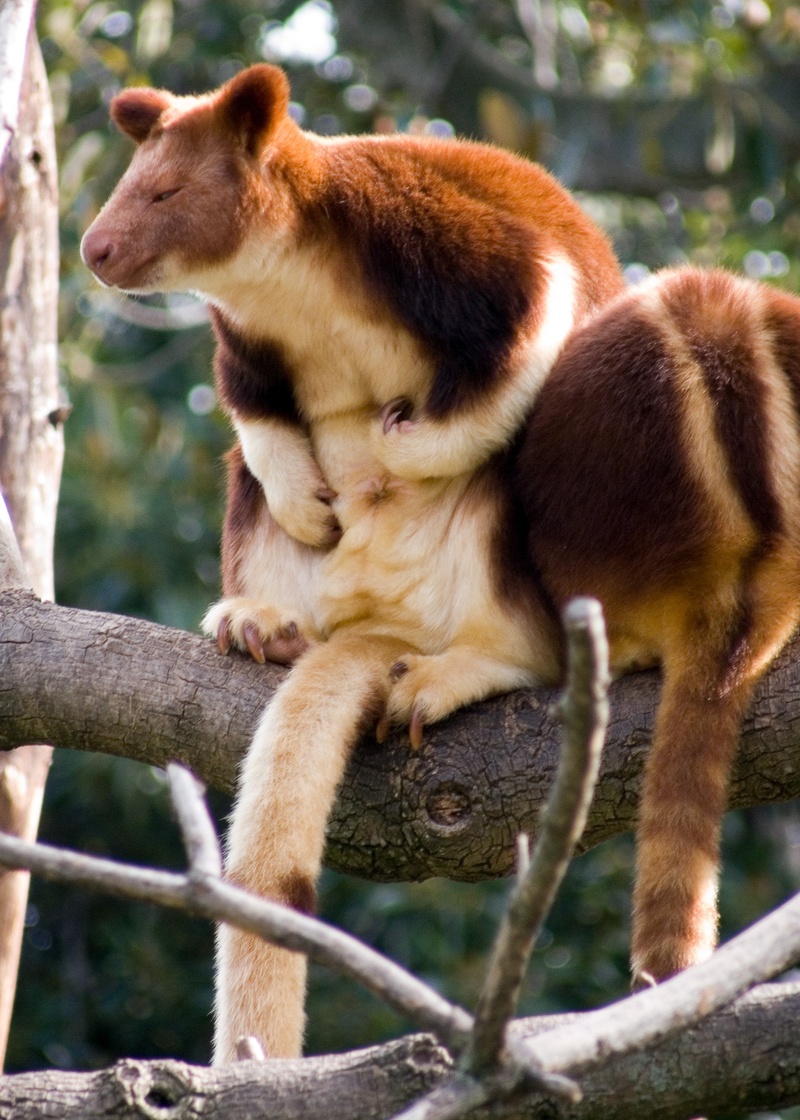
Bennet's tree kangaroo. Unfortunately, we didn't actually see one of these guys. Image source.

The pythons were practiced hunters. They'd often position themselves in ambushes for long periods of time, keeping their white underbellies flush against a tree trunk or root so they couldn't be seen, just waiting for an animal to come along looking for a bit of fruit or a seed. Pythons were particularly drawn by the pheromone signals put out when a Flying Fox bat was born and were wreaking havoc on this population.

Neil had often wondered if pythons picked up the pheromone signals of other mammals. He got his answer shortly before his wife gave birth to their first child. An old farmer who'd lived in the area for decades knocked on his door and told him the tragic tale of an Italian family that lived nearby in the 1930s.

Shortly after having their first child, the couple awoke to find a giant python in the baby's bassinet, with the baby inside the python. In his frantic run to get help, the husband drowned crossing a creek. The woman, devastated after the loss of her child and husband, returned to Italy. (The property this couple lived on was the same property Neil and his family now occupied. After the Italian woman went home, the property was unoccupied for decades, which was probably the reason the forest here was preserved: the logging companies couldn't find anyone to sell it to them).

The farmer was passing along this tale with a bit of wisdom: don't put your baby down or you risk the same fate. Neil reasoned that, just like a newborn bat gave off pheromones, a newborn child did the same. And since it was much bigger it would put out more powerful pheromones, which would likely attract the alpha python in the area. Sure enough, the morning after bringing their baby home from the hospital, he opened the front door to see a six meter snake (that's almost 20 feet!) circling the house. Even though the snake stopped its circling and disappeared back into the folds of the jungle after two weeks, Neil and his wife never let the child out of their arms for the first six months of its life, even sleeping with it. One of the parents always held the baby so its heat signature wouldn't be distinct from theirs--and the python wouldn't try to attack a grown adult. Neil figured that the indigenous people would have relied on this behavior from pythons to get themselves an easy meal after the birth of a child.

Neil recounted some other animal behavior that illustrated just how intertwined the aborigines were with the forest and how their absence had thrown things out of balance. A bird called the Black Butcherbird builds giant mounds on the ground and buries its eggs in the mound. This way the eggs are incubated but the bird doesn't have to risk its safety by sitting on a nest for weeks on end. Unfortunately, this also makes the eggs an easy snack for the Lace Monitor, a lizard that can grow to over two meters. As a result, the Butcherbird and aborigines developed a symbiotic relationship: when a monitor approached one of the egg mounds, the bird would cry out in a particular way and the aborigines -- knowing exactly where the mound was -- would come running and kill the monitor. They got a tasty meal and the bird kept its eggs safe. Thousands of years of symbiosis dies hard and these days the birds still cry out, but no one comes to help them.

It was, in many ways, a magical walk, a look into a world most of us come in contact with only a couple times a year on camping trips or day hikes, and even then we're hardly aware of what's happening around us. My favorite parts were the stands of giant fan palms, whose broad leaves created a roof in some places. This hike is definitely a worthwhile activity if you're visiting the area. We did the four hour version, but there's a two hour version as well.

After our walk we drove ten minutes south to the Heritage Lodge for lunch. The lodge's restaurant sits above a bend in Cooper Creak (which you can go swimming in, at least in this part, without fear of becoming a crocodile's lunch). In the deeper parts, the water was an amazing turquoise color. In other streams the deeper parts might be an emerald color. These hues were causes by the mineral content of the water, and were considered sacred places by the aborigines.
The blue water of Cooper Creek, seen from Heritage Lodge.

After lunch, Sharon and I went to the beach but the sun disappeared behind some clouds and the wind picked up, so we retreated back to the lodge. I didn't feel like sitting in the room, though, so I convinced her to get in the car and go explore the north side of Cape Trib, which had a short trail offering great views of the beach and mountains. We reconvened with her parents later in the evening and had an excellent dinner at a restaurant nearby called Whet, which had been recommended to us by pretty much everyone in the area (and fortunately Sharon had made a reservation there because it was quite busy).
View on the north side of Cape Trib.

Sunday was the sad day on every trip where you have to fly back home to reality. But our flight wasn't until the evening, so we could take our time getting back to Cairns. We started with breakfast at Cafe by the Sea on Thornton Beach. Despite the uninspired name, this small restaurant has the best location in the Daintree. It's steps to the beach, and we sat outside under the eucalyptus trees and watched the tide go out as we ate.
The view of Thornton Beach from Cafe by the Sea.
Thornton Beach.

Next we stopped at the Botanical Gardens, a raised boardwalk that winds through the forest closer to the shore. It was much different than the part of the forest we'd seen the previous day, but was still great to walk through, and the walk only took twenty minutes. Sharon spent much of the time trying to identify Stinging Plants.

Our final stop was at the Daintree Ice Cream Company, whose small shop is hidden behind an orchard containing all manner of tropical fruits. Sharon's dad's hobby is growing tropical fruit in his yard in Florida -- mangos, grapefruit, oranges -- so he was ecstatic. He corralled the caretaker and asked him a bunch of questions about growing fruit. The caretaker gave us a Soursop to try. If you've ever had a Starburst sour apple candy, a Soursop tastes like this, but not quite as strong. The consistency of the fruit is like a creamy peach, which put me off at first, but it is delicious. Then we walked to the ice cream stand itself, which only offered a four flavor taster. It was fine for us though, because the flavors were unique -- soursop, jackfruit, raspberry (ok, this one isn't that exotic), and wattleseed (which had a coffee flavor) -- and delicious. The orchard also has a beautiful setting, which palm trees and flowers spread throughout.
One of the amazing flowers in the orchard.
The view while eating your ice cream.

And after that we drove back along the beautiful coastal road to Cairns and the airport to fly home. If you're taking the time to visit Australia (or are living in Australia), I definitely recommend spending a couple days in the Daintree and doing a walk at Cooper Creek Wilderness.

Sunday, August 26, 2012

Northern Queensland Part 2: Sacrificial Leaves, Neurotoxins, Feral Pigs, and the Jacobson's Organ

This is the second part in a series on a trip to the Great Barrier Reef and Daintree Rainforest. See Part 1

After two leisurely days in Port Douglas we crammed into our hatchback once more and turned north to Cape Tribulation. We passed a few small towns but soon entered no man's land, exiting the main road and taking a ferry across the crocodile-infested Daintree River, which cuts Cape Tribulation off from civilization.

The drive to Cape Trib was stunning. A winding road meandered up and down mountains covered in dense forest. At various points the foliage thinned out, revealing views of beaches and the turquoise sea below. I knew we were in the middle of nowhere when my mobile phone lost its signal. (This was a standard occurrence with my old provider, Vodafone. I could be standing in their corporate headquarters and I still wouldn't be able to make a call. Since changing to Telstra the coverage has been so much better so I knew when I lost a signal we were "out there".)
One of our stops on the way north to Cape Trib
View of the ocean from the road in the Daintree.

We checked in to the Ferntree Rainforest Lodge, a collection of stand-alone rooms about a kilometer from where the paved road turned into a dirt and gravel track (if you want to keep heading north, better get yourself an SUV). Then we walked down the road to the beach. At the entrance signs warned us of crocodiles. The water near the shore was a bit murky and it wasn't hot enough to be inviting for a swim, but the beach was beautiful -- palm trees formed a border along the sand, blocking any sign of humans, streams cut to the sea through the forest, mountains rose up in the west. 

We walked along the beach for a while before coming to one of the streams, which cut us off from the rest of the beach. Sharon and I stood there a few minutes while I debated the merits of crossing: on the one hand, I could get to the other side; on the other, I could get eaten. It was a tough call. Ultimately, I decided not to cross (I think the idea of being featured on the evening news under the headline "Dumb American gets eaten by crocodile, despite signs everywhere warning people about crocodiles" was the clincher). We headed back to the lodge for a taco night special they were offering. There's a scientific theorem that postulates the farther away you get from Mexico, the worse Mexican food tastes; we were pretty damn far from Mexico. Some places should just stick with the basics.
Watch out for crocs!
Walking along the beach in Cape Tribulation in the late afternoon.
The tropics!

On Saturday morning Sharon booked a four hour private guided walk through the forest at Cooper Creek Wilderness, a large tract of private property in the Daintree. Our guide for the walk was Neil, a sturdily built man who lives on the property with his wife and kids. After getting his university degree, he spent seven years teaching aborigines in the Tanami Desert in Australia's Northern Territory (and likely learned quite a bit from them as well) before buying the Cooper Creek property, where his family had lived for 26 years. Because it was part of protected area they were very restricted in how they could live -- for instance, all their power was from solar panels or generators because they couldn't bring in power lines from the road.

As we walked through the forest Neil told us its history and shared with us some of its secrets. The Daintree (named for a Mr. Daintree, not a Dain Tree) is the oldest forest in the world, a remnant of when the planet's landmass was a vast supercontinent called Gondwanaland. Its significance wasn't discovered until the 1960s when it became a hot spot for hippies. Around the same time, ranchers bringing their cattle from farther north down to the market at Cairns would let the cattle rest and fatten up nearby. The hippies didn't like the cows destroying the area and often butted heads with ranchers.

One day a rancher found a few cows dying and suspected they were intentionally poisoned, despite the fact that this would be very un-hippy like. He called a veterinarian who discovered a unique seed in the stomachs of the cows. He sent it off to Queensland's agricultural laboratory and the researchers couldn't believe what they were seeing when they did their analysis: it was the botanical equivalent of finding a living dinosaur. All the biologists had been busy studying the 20,000 year old forest south of the Daintree River, and just north of it was a 165 million year old forest.

Logging devastated much of the area before it was declared a World Heritage site. A single 700 or 800 year old tree could bring in $70,000-100,000. But because the network of vines and trees is so dense, to cut down one big tree, you need to cut down all the little trees and vines around it to actually get it to fall, otherwise these informal support structures will keep it standing. Simply replanting isn't a solution because when a big cyclone comes through it will tear down any trees without this support. Cyclones come through about once every seven years  (which means about 24 million cyclones over the life of the forest).

As Neil was giving us this background a Cassowary wandered out of the brush behind him. The Cassowary is a giant bird that looks like a cross between an ostrich and a dinosaur. It's the largest animal in Australia (yes, even larger than Kangaroos in terms of height). It's also endangered, which is why seeing one up close in the wild was so remarkable.
A Cassowary stepping out of the brush...

They're endangered thanks to a surprising culprit: pigs. There are roughly 24 million feral pigs in the Australian wilderness. About 60,000 of them reside in the Daintree and are wreaking havoc. All along the trail we saw spots where pigs had destroyed large patches of plant growth. They're out-competing the Cassowary for food, which has driven the Cassowary population down to about 1,000 birds.

Given the precarious population the government does what it can to protect them. There are a few dozen signs along the only road in the area warning people to slow down for Cassowaries; these are accompanied by a varied array of speed bumps. They're serious about protecting the birds, and with good reason. Obviously, the extinction of the Cassowary would be tragic, but because of its unique place in the ecosystem and its role spreading seeds in its waste (the digestive process actually makes some species of trees "growable"; otherwise they'd just rot on the forest floor), it's estimated that the loss of the Cassowary would lead to the loss of 30 species of plants. That's quite a domino effect for one animal.
Someone's modification to one of the many signs warning drivers about cassowaries.

The forest was a world that operated on a chemical level, remaining invisible to the untrained human eye. As we walked around Neil pointed out some of the actors that participate in this complex ecosystem on a daily basis.

One type of plant utilized sacrificial leaves. A single soft, pink-hued leaf would stand out amongst the green. Any insects looking for a snack would be drawn to this attractive leaf before attacking the green leaves. But once the pink leaf was attacked, a chemical signal would be sent to other plants to temporarily change their chemical makeup in their leaves, making them unpalatable. Even crazier, the plants in one area would rotate who displayed the sacrificial leaf, so one plant wouldn't take the brunt of the insect feeding frenzy.
Sacrificial leaf.
Neil also showed us a small mushroom the size of a nail head that glowed at night to mimic the female firefly. This mimicry attracted the male firefly, which would pick up spores when it landed and spread them around when it took off. The way plant life had evolved to exploit insect and animal life was impressive. One tree actually co-opted ants, beetles, a species of bird, and possums to keep away would-be pests and repair damage to its bark. Another tree emitted hydrogen cyanide, a poisonous gas, when attacked.

One tree species, called a Cycad, existed in the days before flying insects and -- since if it ain't broke, don't fix it -- still used flightless insects for pollination. The male cycad has a dome at the top of the trunk that is home to a number of insects. When it comes time to pollinate a female, it will raise the temperature in its dome by about 17 degree Celsius (that's over 60 degrees Fahrenheit). To escape the heat, all the insects will evacuate the male tree and hustle across the forest floor to the female tree to take up residence, taking bits of male pollen with them. When the female tree has been pollinated, it will raise the temperature in its dome, sending the insects back to the male tree.
 
Neil pointed out an innocuous looking plant, which has various named, but is generally called the Stinger or Stinging Tree. This is Australia's typically more venomous version of plants found in the rest of the world, like Poison Ivy. Touch its leaves and silica-tipped hairs will deliver a nasty neurotoxin. The excruciating pain the toxin causes can last for months and often requires hospitalization. An Australian Geographic article covered some of the consequences of contact: horses going mad and jumping off cliffs in agony, a military officer who shot himself after using the leaves as toilet paper, and pain returning years after exposure simply from taking a cold shower. The British were allegedly investigating its potential use for chemical warfare back in the 60s. Given the wide berth most animals give this plant, other species of plant have evolved to resemble the Stinger as a defensive ploy.

This plant gave off no smell or other hint of its danger, but Neil commented that if you brought an Aboriginal elder near a Stinger he likely would know he was close to one even if he couldn't see it. This comment came up because I was joking about a particular seed we passed. The seed looked like a cobalt blue egg and was a favorite snack of the Cassowary. Neil mentioned that aborigines could eat it after some significant processing and I quipped that the first person to eat it probably died, so the second person prepared it a different way and he died, so a third person tried it a new way, and on and on until someone figured out a recipe that wouldn't kill you. Very persistent people, I said.
The aforementioned blue seed.

The more likely situation, however, was that the aborigines were so in tune with the environment that they would have known just how to prepare it to neutralize any toxicity, just as animals somehow know which berries are safe to eat. Neil talked about how, after 26 years living in the Daintree, he was much more aware, unconsciously so, of his surroundings. (He amazed us on numerous occasions by pointing out insects on trees that were so well camouflaged you had to look hard to see them even when he pointed right at them. Imagine what he might know if he'd spent the first half of his life in the forest, coupled with knowledge gained and passed down through millennia.)

Much of this aboriginal "sixth sense" would have been thanks to the Jacobson's organ, found at the base of the nasal cavity, he said. The organ detects pheromones, which are the chemical messengers of the forest. While studies on whether adult humans have a functional Jacobson's organ are inconclusive, Neil surmised that the Jacobson's organ in someone who'd spent his life in the forest would be much more developed than a city boy's, and that most of the studies have probably been conducted on people who did not spend their lives living in the wild, so to speak. It was an interesting idea, and served to remind us how detached from nature our lifestyles have become.

To be continued...

Wednesday, August 15, 2012

Northern Queensland Part 1: A parallel universe in the Great Barrier Reef

Sharon's parents were brave enough to suffer through the 20+ hours of traveling it takes to get from Tampa, Florida to Sydney, Australia, and spent a couple weeks visiting us here. On her mom's bucket list was the Great Barrier Reef, so we planned a short excursion up to northern Queensland. Since her parents were coming from a Florida summer (read: very hot and humid), Sydney's rainy winter was a bit of a shock. And since apartments here don't have central heating, they were huddled up in front of our space heater. The warmth of the tropics was going to be a welcome escape.

But as we sat in the Sydney airport, delayed hour after hour thanks to some fog that perched itself on top of the runway, it looked like we might not be going anywhere. We used the time to book some excursions and I tried out my new iPad by sketching Australian animals. It's been a long time since I doodled and I enjoyed it. And finally the fog lifted and we left.
One of my drawings.

The descent into Cairns (pronounced more like "Cannes" -- the French city -- than "Kairns"), the biggest city (and I use that term loosely) in northern Queensland, was amazing. As we passed over the ocean, patches of light turquoise blue-- indicating where reefs were -- stood out from the azure water. Lush mountains sloped down to the sea. While I knew that Australia boasted a varied landscape, if you had shown me a picture I would have thought this place was in tropical southeast Asia.
A lot of blue from the window...

We picked up our rental car, a small hatchback that was a bit snug for four people, and turned north on the main road (ahem, the only road) to Port Douglas, the jumping off point for exploring the reef in the area. For the first few miles outside of Cairns we were subjected to roundabout hell. In lieu of traffic lights, the traffic authority left all the motorists to luck and fate and installed huge roundabouts at every intersection. It might have been a better experience in a sports car, but the hatchback didn't exactly hug the curves. But after a while the roundabouts gave way to smooth, uninterrupted road.

We passed sugar cane fields and banana plantations, the mountains always a short distance behind, and occasionally were treated to spectacular views of the ocean and coastline ahead. It's Australia's answer to the Pacific Coast Highway in California. About an hour and a half later we rolled in to Port Douglas. Port Dougie, as it's called, is a charming town, flanked on one side by Four Mile Beach and on the other by the ocean and wharf where all the fishing, snorkeling, diving, and leisure cruise boats depart. Four Mile Beach, I learned, often hosts saltwater crocodiles, but we didn't see any when we went for a walk after checking in to our hotel.

Because of the delay in Sydney, the day was mostly over. We got some dinner and went to bed.

The next morning, on Thursday, Sharon had booked a snorkel tour of the outer reefs (which is apparently better than the reefs closer to shore). It was warm and sunny and promised to be a great day. Some of the snorkel and dive operators have enormous boats that hold over 100 people. We didn't want to have such a commercial experience or share the water with so many people, so we'd found a catamaran that held about 35 people. As we cruised towards the outer reefs on a calm sea I picked up the accents of the other guests -- most were American. Two dolphins passed us by and a short time later we caught up with a few humpback whales.
View of the coast as we headed out towards the reef

The boat had three planned snorkel stops, all offering something a bit different. When arrived at our first location Sharon and I dove in sans wetsuits. After all, we were in the tropics. However, it was still winter and the water was cold. We retreated back to the boat, donned some wetsuits, and --  appropriately clothed -- jumped back in.

From deck of the boat you could see where the reefs were because of the colorations of the water, but its secrets were still hidden. But as soon as we ducked our eyes below the surface of the water, a parallel universe was revealed: thousands of multicolor fish, forests of coral, giant clams, sea cucumbers (and yes, we saw the Little Nemo fish: quite plain compared to some of the other species). It was unlike anything we'd ever seen. With the buoyancy from our wetsuits, we spent a lot of time just floating in place, watching the fish swim around, and wondering at the incredible variety of life on this planet.
Brain coral.
Sharon waving.

The second reef we stopped at had the best coral. Tentacles of dark purple coral rose from the ground and spread for yards in all directions. Giant brain coral that was hundreds of years old  We even saw a reef shark, which I tried to follow for a while as it lazily moved through the water.

Our third snorkel spot was difference once again: two massive pillars of coral rising from the sea floor. This spot had the most vibrant collection of fish. I also saw a large octopus gliding along the surface of the coral. We were mesmerized by the beauty. If the cold hadn't finally gotten to us, we could have just floated there for a long time.
If our camera didn't suck, this is what our photos would look like. Image courtesy.

Our boat returned to Port Dougie in the late afternoon. There was some excitement on the boat when the captain received a radio call the an albino humpback, the only one in the world, was in the area after disappearing for a couple years, but we unfortunately couldn't find him. After cleaning up at the hotel, we hit the town for some dinner and ice cream and prepared to head further north, to Cape Tribulation and the Daintree Rainforest on Friday.

Saturday, August 4, 2012

Crazy Ass Birds!


The last time I was in Miami I was amazed at how many iguanas’ I saw. Once, while walking with my sister we saw 20 iguanas chilling in a bush. After riding the NYC subways for 7 years, I was still surprised when I saw a rat scurry by. Yuck!

But now living in Australia we have those Iguanas and rats beat! They have the largest and most diverse range of birds that I have ever seen… or heard. Some are beautiful while some not so much but ALL are loud!

Not only are they loud but also they are very intrusive! Not sure where these birds learned their manner but it wasn’t in Casa de Laufer. Adam and I have had birds fly into our kitchen window or balcony door on many occasions! Some just come in for a look around, some take food and some even poo on carpet. The nerve of these birds!

Here are a few of the birds that have visited our balcony.


To see my favorite bird visitor ever read my post HERE.


Man, these are some crazy ass birds!