For Part I, go here.
For Part II, go here.
Thursday we
continued backtracking and drove from Halls Creek to Fitzroy Crossing. This
drive was slowed -- just a bit -- because we'd pull over to check on other
travellers stopped on the side of the road.
About 30
kms past Fitzroy Crossing we left the blacktop and turned north on the Leopold
Downs Road, a dirt and gravel road that was in good condition for the most part
but whose bad sections seemed they might rattle the Pajero to pieces.
After an
hour along this road we came to a huge water hazard. A pond basically sat in
the road. On one side, trees prevented circumventing it and on the other the
pond emptied into a creek. Shit.
I got out
of the car and walked into the pond to see how deep it was. It was only halfway
up my calves but the bottom was very soft and muddy. I worried about the truck
just sinking in the mud to the point that it got stuck. There were also a few
big rocks that might trip us up. Whereas other roads had at least had the
occasional traveller, we hadn't passed anyone, so if we got stuck we could be
waiting a very long time for help.
If I went
around towards the creek side, I'd be able to keep one side of the truck mostly
out of the water, but couldn't see what was below all the soggy grass (and I
was still paranoid about puncturing another tire). I decided to do it anyways
and slowly churned across; the passenger side was firmly in the pond and the
car was at a 45 degree angle. Sharon could have stuck her hand out the window
and scooped up the water. But we made it. Safely across, we rumbled to our
first stop, Tunnel Creek.
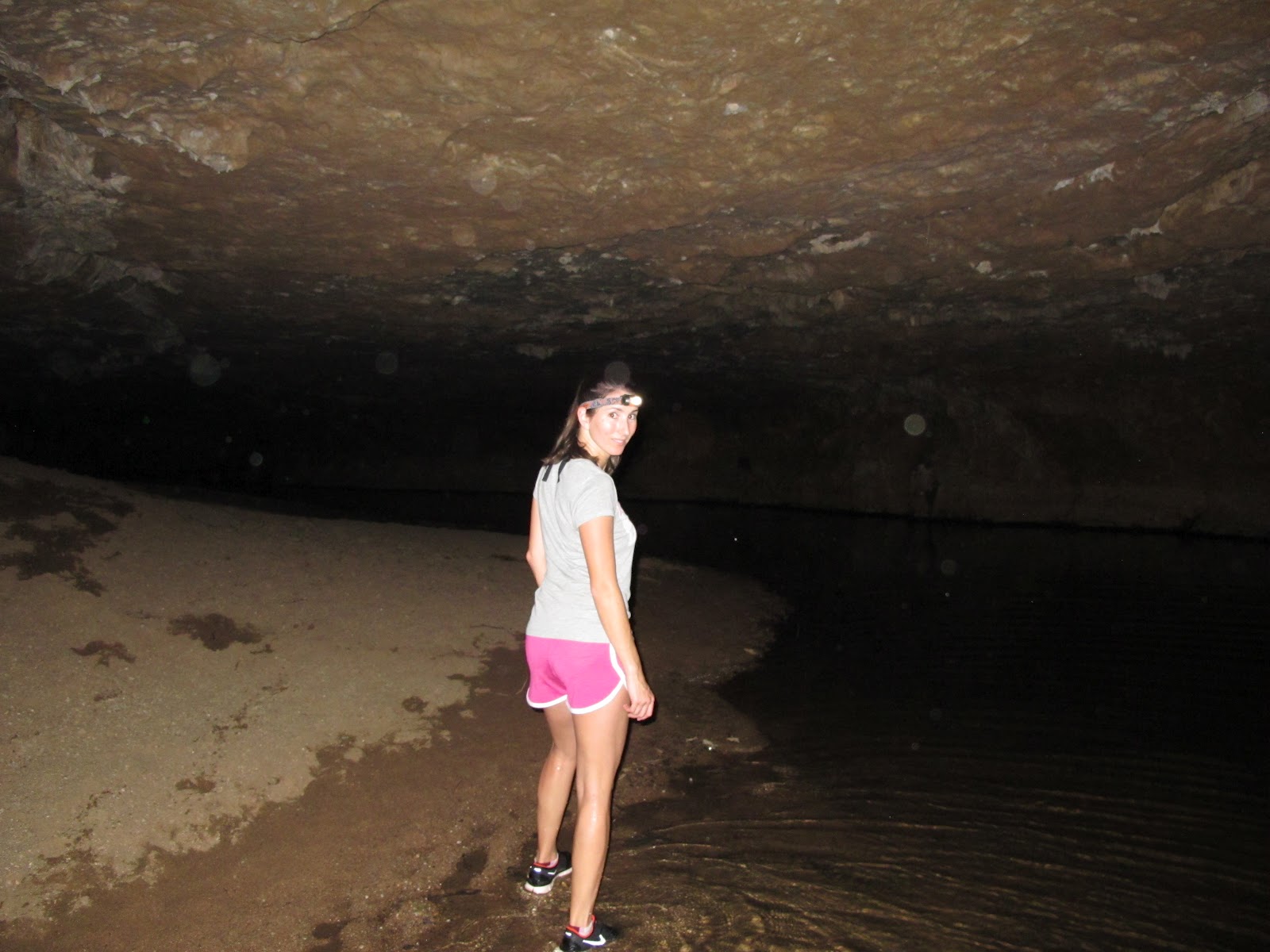
Tunnel
Creek, as the name suggests, is a large cavern formed by a creek cutting
through cliffs (yet another remnant of the Devonian Reef). To enter, you walk
from the parking lot down a short trail to the creek and crawl over a number of
quartz boulders. It gets pitch black quickly, so you need a flashlight. The
hand-held kind (mine) worked better than the kind that strap to your melon
(Sharon's).
 |
| The way into Tunnel Creek. |
 |
| A bit of light enters midway through. |
 |
| An internal waterfall. |
 |
| The ceiling. |
 |
| Welcome to the other side. |
Our
flashlights illuminated fish, crayfish, tiny frogs, and bats in the darkness.
The tunnel is probably half a kilometer long. We had to wade through the water at several
points, but it was never deeper than mid-thigh. The tunnel terminates on the
far side of the cliff and we were greeted with a beautiful scene of the creek
widening out, flanked on both sides by trees. We hung out for a bit before
going back through the tunnel.
 |
| The view on the far side of the tunnel. |


As we
returned to Leopold Downs road to head on to Windjana Gorge, our campground for
the night, we passed a sign that had amused me. It simply said "Dip"
and warned against a dip in the road ahead. We passed several of these
"Dip" signs. I would see them and think, "Dips? Seriously? What
about the ten other dips and multiple water hazards there weren't any signs
for? Why even both to put any signs up since the whole road is a mess?"
We also saw
a curious result of the controlled fires. One side of the road would be a lush
green and the other would be blackened from fire, the trees' leaves cooked to
an orange-brown. It was like the road straddled two worlds.
In late
afternoon we arrived at Windjana Gorge and set up camp. This campground was
more open, and more crowded, than the campground in Purnululu, though half the
spots were still free. It also thankfully had showers and toilets with running
water (and the showers even had hot water!). We made chicken schnitzel and
baked beans and sipped on our expensive beers while the evening cooled a bit.
Fire was permitted in this park and a few campers started roaring bonfires.
When it got dark we climbed into the tent to read a bit, free from the
mosquitoes, and went to sleep early.
Friday
morning we walked to Windjana Gorge, known for hosting up to 80 freshwater
crocodiles. Freshies, as they're called, generally don't get any larger than 3
meters and aren't considered a menace to
humans unless provoked. The crocs were the key attraction for me and I was
pretty bummed that we didn't see any when we started our hike through the gorge
around 8:00am. But by the time we were on our way back we saw about a dozen
lounging on the opposite bank.
 |
| Windjana Gorge. |

 |
| Freshie. |

After
Windjana, our plan was to go to Bell Gorge, which is supposed to be among the
most beautiful gorges along the Gibb River Road (which has tons of gorges). Unfortunately this was closed
for some reason so we decided to skip ahead to the next stop, Manning Gorge. We
spent a final half hour on the Leopold Downs Road before turning north on the
Gibb. Initially it was paved, which got me excited that it would be a smooth
ride. That was naïve, though, because it quickly gave way to the standard
packed gravel and dirt. Still, it was in the best condition of the offroad
roads we'd been on. But like the others it had its rough parts that just
hammered the miles in.
 |
| Queen Elizabeth's Head on the right, seen driving north on the Gibb. |
Along the
road we saw our first wild dingo. It was snacking on a kangaroo killed by a
truck and flew off into the woods as we approached. We saw another dingo a
short time later. Cows once again roamed in front of us and a quick horn blast
dispersed them.
 |
| Our first wild dingo. |
From
Windjana to Manning was a three hour drive. We had to stop at a roadhouse near
the entrance to pay the camping fee and also bought an extra bag of ice, which
cost $10.50. Supplies in this part of the world are hard to get and are pretty
expensive as a result. The campground was mostly empty, so we picked a spot way
from others, made lunch, and then went to explore the gorge.
To get to
the gorge you first have to cross a wide stream. There are styro-foam boxes so
you can float your stuff across, but there's no avoiding getting in the water.
The setting is paradise, though. Tall palms and eucalypts border the water. A
large rock provides a resting point midway. If this was the destination we
would have been quite content to swim around and soak in the view. But really
this is just the starting point to the gorge. Sharon and I thought it was quick
hike so were wearing bathing suits and flips flops. In reality, it's a very
rocky trail. Even the term "trail" is being a bit generous, since
really it was just hills and hills of large rocks, with the occasional white
dot painted on one to indicate you're still going the right direction. It took
us a good 45 minutes to get to the end and one more than one occasion we
wondered if this was a big joke and we were the suckers.
 |
| The start of the trail to Manning Gorge. |
 |
| Sharon wades across. |
 |
| Can you find the trail? |
 |
| We made it! |


 |
| My goanna. |
 |
| Walking back from Manning Gorge. |
All the
hard work was worthwhile as soon as we caught a glimpse of the gorge, though.
Manning Gorge was my favorite spot on our trip and I could have spent the
entire day there. A wide waterfall poured into a large pool perfect for
swimming. The stream continued on to other swimming pools, bordered by
sandstone cliffs and plants. I found a goanna and snuck up to take a close-up
photo (I later learned this is a bad idea as they can run up your body with
their razor sharp claws). Sharon and I soaked in the atmosphere for an hour and
a half or so, and then had to head back before it got dark. Even in the
daylight we lost the trail a couple times, so navigating in the dark would be
impossible.
On our way
back across the stream, we saw an old man on the far side; he could have passed
for Father Time with his white beard. He was wearing mechanic's overalls with a
bottle of beer tucked firmly in each breast pocket. He plunged into the water
and swam to the rock in the middle, where his wife was already waiting,
dripping wet in her full set of clothes. They cracked open the beers and soaked
up the sun on the rock. You meet a lot of characters on the Gibb.
While we
were setting up dinner three tour buses rolled in. Each discharged 25 or so
people and it hinted at how much more populous the campgrounds would be when
the tourism high season arrived in June. Most of the tour bus passengers were
in the 50s or 60s, with some even older. We watched many limp their way to the
bathrooms. How on earth were they going to hike to Manning Gorge, we wondered.
 |
| If you don't want to do the trip yourself, this is what you'll travel around in. In the wet season they're used to transport miners. |
Manning
Gorge was our northernmost point on the Gibb River Road. After Manning the
tourist sites are fewer and there isn't any place to refill your gas tank until
you hit Kununurra, about 350 kms northeast. There were other sites back down
the road in the direction we were heading, but many of these were a good
distance off of the road down their own rickety tracks. So because Bell's Gorge
was closed we decided to make one final stop at another famous gorge and then
head back to Broome. Instead of spending our Sunday driving, we'd be able to
spend it lounging on the beach.
Galvans
Gorge was only about 30 minutes south of Manning Gorge, and is one of the
easiest to access. A one kilometer walk takes you to a waterfall plunging in to
a small swimming pool. The waterfall cascades down a few levels with a giant
boab tree on top overseeing everything. We were there early -- about 8:00am --
and had the place to ourselves for a short time before another 25 people
arrived. The heat of the day hadn't penetrated the tree cover to warm the day
yet, but we swam around and hung out under the waterfall anyways.
 |
| Galvans Gorge. |
 |
| Loved that Boab on top. |
 |
| Driving back down the Gibb River Road towards Broome. Nothing to see here. |
We were
back on the road by 10:30 and headed to Broome via Derby. There isn't much to
see in Derby apart from the famous Boab Prison Tree. Boabs have fat trunks that
taper at the top -- they're also referred to as bottle trees -- and the bigger
ones are suspected of being thousands of years old. There's no way to tell as
they don't have tree rings, however. The oldest, and hence the biggest, were
occasionally used as temporary prisons. The settlers would hollow them out and
stick aborigines in them.
This
particular prison tree in Derby was used as a holding cell for young aboriginal
men who'd been kidnapped by settlers to do forced labor for the pearlers in
Broome. The white pastoralists went along with this and often aided in the
kidnapping because they thought if the aboriginal communities lost all their
young men, the communities would be docile (it didn't work). Many old Boabs
also featured in aboriginal religious belief and the Derby prison tree was
among these, so was fenced off.
 |
| Derby prison tree. |
When we got
back to Broome we had mobile phone service again. I instinctively got out my
phone to check email and Facebook, but stopped and put it away again. I wasn't
ready to be connected. Sharon and I joked about how hard it would be to adjust
back to the hubbub of Sydney.
Since we
were back in Broome a day early we didn't have anywhere to stay. We found a
caravan park overlooking the water that allowed campers and picked up a spot.
But whereas the Kimberley got quite chilly at night, Broome stayed sweltering.
I opened the tent flap a tiny bit to let in some of the sea breeze in the hopes
that it would cool down enough for us to sleep. I dozed a bit but jolted awake
at the telltale sound of buzzing. Mozzies had breached the castle walls! Sharon
and I spent the next half hour killing all the mosquitoes in the tent. The
paper towels we used were spotted with blood (our blood!) and Sharon's skin
showed their handiwork in the morning.
I was
grateful when daylight arrived. We packed up camp, ate breakfast overlooking
the ocean, and returned the camping equipment we rented. Since the truck was coated inside and out in the
fine red dust from the road I also decided, in the interest of avoiding
Europcar's cleaning fee, to take it to a carwash. We spent a couple hours at
the beach and then headed to our accommodation for the night, the Lord McAlpine
House.
This house
was initially the home of a prominent pearler and was purchased in the 90s by a
British politician, Lord McAlpine, who expanded it and used it as his home when
he visited Broome. The home was subsequently sold and turned into a boutique
hotel. I figured we'd want somewhere nice to decompress after camping and this
place was perfect. It only had eight rooms so was very quiet. Lush gardens
(with over 100 species of native plants) shut out the world around the
property. Sharon and I sat next to the pool and read all afternoon. It was a
nice way to end the trip and I would have been happy to spend another day just
lazing around there. But alas, all trips come to an end so Monday we waved
goodbye to Broome and flew back to Sydney.
 |
| Veranda of original house at Lord McAlpine House. |
 |
| View of the parrot houses. |
 |
| Communal breakfast table. |
 |
| One of the amazing trees at Lord McAlpine house and one of Adam's Top Ten Trees of All Time. |
Sharon had
never camped in her life and I hadn't gone camping for probably fifteen years
or so. This trip certainly didn't make us into serious campers, but it was fun
and Sharon embraced it. I told her, "You're a good adventurer, Sharon. And
no matter how much trouble I get us in you're always game for more."
Oh, and
that tire? $287 to replace. Ouch.
Things to consider and advice if you go:
Timing
Peak
tourist season is June-August. The earlier in the season you go, the greener
and wetter things still are. It's supposedly pretty dried out and dusty by
August. Most of the roads open in April but that's still a pretty risky month. We went May 5-14. Everything was still lush and the waterfalls were
very impressive (they dry up too), but the roads were pretty rough. We saw
workers grading every road we were on: the Mabel Downs track,
Leopold Downs, and the Gibb. Also, it's possible the road to Bell Gorge would
have been open if we'd gone
later (although nothing is ever a guarantee out here). So a couple weeks later in the season we would have had a smoother ride and been able to see everything we
wanted. On the other hand, you'd be sharing the sites with more tourists. And
in June, some campgrounds get completely full and you can't enter until someone
leaves.
Tire check
I never
would have thought of this until it
happened to us, but if you have a rental truck make sure you can loosen
the wheel nuts with the spanner wrench that comes in the rental. Flat tires are
a fairly common experience on the tracks (we met one group who'd had three). If
you can't loosen it find a mechanic who can do it for you, and then tighten
them yourself using your own strength. That way you'll know you'll be able to
take them off if needed. You should also carry a tire gauge so you can measure
your tire pressure -- you need to lower the pressure when you go offroad to decrease the risk of a puncture.
Prep time on either side of your trip
I recommend
leaving yourself at least one full day on either side of your trip for prep and
clean-up -- getting gear and food, figuring out to pack the truck the best way,
and cleaning all that dirt off at the end. Plus, if you have a truck issue and get delayed, you won't have to worry too much about missing your flight home.
Planning your trip
This
website (http://www.kimberleyaustralia.com/)
is useful but I highly recommend purchasing the site's PDF guide to the Kimberley. It
has a huge amount of good information on sites, itineraries, and other things
you'll need to plan.