Tuesday, February 28, 2012

Blue Mountains: Round 3

With our friends from New York, Luke and Mandy, visiting us for 10 days, we decided to take them to the Blue Mountains their first weekend.

The first time we went there, with Sharon's sister Dalia, it was so foggy we couldn't actually see anything. The second time, with my brother Andrew, we could actually see what was around us, but the day was overcast and we got rained on.

Both of these times we had gone to Katoomba, the main tourist spot; this time around we decided to hike a trail in Wentworth Falls to mix it up a bit. As we pulled into the parking lot, this attempt seemed destined to be a repeat of those earlier experiences: dark clouds were gathered up over the area, threatening rain at any moment.

Starting at the top of a plateau overlooking a  valley, we meandered down a very muddy path towards the falls. We walked across a short rock bridge across the stream at the top of the falls, just a few short hops from where it plunged hundreds of feet to the valley floor.  A very steep staircase winded its way down to the bottom. About halfway down the rain let loose, which was soon accompanied by some impressive thunder.
About to begin our descent down some very steep stairs. Mandy is freezing in the back.

Once at the bottom, I made us stop to consider whether to go back or press on given the very real possibility of being caught in a serious storm with no gear. No one was interested in going back up the stairs we just came down, though, and Sharon, whose middle name is "Damn the torpedoes, full steam ahead" wasn't about to entertain a retreat.
A wet shot at the bottom of the first waterfall.


Under the waterfall.

The main waterfall from a distance.

We decided to continue, which turned out to be a good decision; the view of the falls from various points of the trail was spectacular. And as we began our climb up another path something wonderful happened: the rain stopped, the clouds cleared, and the sun beat brightly upon us, drying out our soaked jeans and t-shirts.

Our trail, about halfway up the cliff face, wound past a few more waterfalls, though none were as impressive as the first. We even encountered some people in wetsuits rappelling down the ravine carved by one waterfall.

Unfortunately, what goes down must come up, and there were several hundred steps to reach the top of the plateau where we started. Mandy, who grew up in the flat country of Ohio,  told us the ascent was the hardest thing she'd ever done. As a reward for our efforts, we were treated to a stunning view of the valley and tablelands at a lookout point about three quarters of the way up. At the very top we collapsed at a café overlooking the area and ordered up some milkshakes and snacks.
The view from the top...with much improved weather.

We then took Luke and Mandy for a quick spin over to Katoomba so they could see the Three Sisters, the most famous rock formation in the Blue Mountains, and decided to head to the hotel to check in, get cleaned up, and find a restaurant for dinner.

We plugged the hotel address into the Garmin and begin following its recommended route. As we approached the destination, the pink line on the screen didn't deviate off the main highway like I expected it to. This meant the hotel was on the highway. We hadn't passed anything that looked promising on the way in. This can't be good, I thought.

We soon came to an enormous pink building called the Grand View Hotel. "This is it," Sharon confirmed. We parked around the back and entered the building through a large pub, walked through it and out into a hallway. We couldn't find the check-in desk. I wandered over to the bar and asked where it was.

"This is the check-in," the woman informed me. I knew it was going to be bad. We got our keys and walked up the stairs to the second floor, along a dingy hallway, and to our rooms, passing the shared men's and women's bathroom along the way. Sharon was first through the door of our room. "Oh, Adam," was all she said. Those two words made my heart sink: it was going to be very bad.

At one time in the 1900s, the room's carpet would have been pink. It was now brownish-pink, with a number of particularly high-profile stains throughout. The walls were scuffed and dirty. The room had a dresser, a bed, a chair, and a sink. The bed looked like a hand-me-down from the first Australian convicts. I've stayed in some awful places before (see Exhibit A: Hotel room with Hummer blanket), but even this place skeeved me out.
Exhibit A: Hotel room with Hummer blanket

"I'm not going to put my head on the pillow because I don't want to get the flesh eating virus," Sharon wailed.

Luke and Mandy were having a similar reaction in their room.

"I'll protect you." Luke offered.
"From what? Bed bugs?" Mandy replied.

Luke and I headed to the showers to wash off the dirt and sweat from the hike. The bathroom did have two separate shower stalls, separated by a wall. We shared shampoo and conditioner by throwing them over this wall.

From his side of the wall, Luke made a very good suggestion: "You know, we don't actually have to stay here; we're only an hour and a half from home."

"That's true," I replied. That it took someone from New York who had been in Sydney all of 36 hours to make this observation was somewhat embarrassing. But I wasn't going to let that stop us. I went back in the room and told Sharon to pack it up.

We went to the bar to check out. When the bartender asked for a reason more specific than "the rooms look much worse than on the website" I said they were so dirty looking I didn't want to touch anything. We didn't get a refund since the hotel claimed they advertised themselves as a "budget hotel" -- that is true, but budget doesn't necessarily mean disgusting. There's a little chain of places in the U.S. called Motel 8 that's capitalized on this reality. At $100 a pop, those showers turned out to be the most expensive of my life.

We drove back to Sydney and had dinner in a tiny, charming French restaurant in Elizabeth Bay called Café No. 9. Then we spent a beautiful Sunday chilling at the beach followed by ribs at Hurricanes. Despite the snafu at the Grand View, it was a great weekend and was great to have our friends in town.
The Browns' last night in Australia.

Sunday, February 26, 2012

Tasmania in Four Days: Part 2

We were glad to put Orford and the East Coast Resort behind us as we made our way to Port Arthur, a historic penal colony way down in the southeast of Tasmania, on the Tasman Peninsula.

Sharon, who was the master planner for the trip, had a couple stops scheduled for us along the way. Shortly after crossing a narrow strip of land onto the Tasman Peninsula, we made a slight detour through Doo Town, a tiny village overlooking the water (as most towns do in Tasmania), to see two geological formations: the Tasman Arch and Devil's Kitchen.
The Tasman Arch was, a very long time ago, a giant sea cave. Eventually, part of the roof collapsed, creating a huge arch. You can walk onto the arch and get a great view of the southern end of the Tasman Peninsula. Near the Tasman Arch is another site called the Devil's Kitchen and we hiked the short distance to it.
Tasman Arch

"So this is the devil's personal kitchen?" someone joked on the way.
"Hope he cooks us breakfast," Sharon quipped.
"Deviled eggs, of course," said Alex.

Like the arch, this was also once a sea cave but the entire roof caved in, so that now it's a long, deep rectangular-shaped gorge cutting into the sea cliffs. Nothing about it suggested "kitchen" or "devil" in my mind so I think someone named it just to add a sense of drama and attract visitors. We took it all in for a few minutes and then headed back to the car, which was by now a light shade of dust from our travels.
Looking down towards one end of the Devil's Kitchen. Yep, I didn't see it either...

Another thirty minutes down the road, we stopped at  the Tasmanian Devil Conservation Centre, which had been recommended to us.

The Centre had somehow photographed a devil in a moment of cuteness and used that as the face of their advertising. Sharon couldn’t wait to see one up close and personal. Moments of cuteness are few and far between with these animals, however. About the size of a large house cat, they look like overgrown rodents. Their hips seem too low for their shoulders, so they don't run so much as lurch. They are awkward looking creatures.
The cuddly Tasmanian Devil.


Sadly, they are facing extinction due to a mouth cancer transmitted when they bite each other (which is all the time). They get particularly violent around mating season. The males fight viciously for the right to mate, and the victor then assaults the female to make her submit.

The Centre had roughly 30 Devils spread across a collection of natural enclosures. Eventually they'll be released into the wild. We happened to luck upon a feeding, which happens very inconsistently -- Devils are scavengers, so to replicate the conditions they'd face in the wild, sometimes they aren't fed for days.

The keeper came to the enclosure with a bucket of indiscernible animal chunks. The Devils, knowing what was coming, stood on a rock and began growling. This isn't a growl like a bear or dog or lion; it's almost whispery in a way. Early settlers thought the sound was the devil talking, which is where the animals got their name.

When a chunk of animal was thrown into the enclosure, the quickest Devil picked it up and took off running. The other two sharing the enclosure took after him. They ran in circles around a mound over and over and over. One lagged so far behind that if he had just stopped and turned around, the leader would have run right into him. These aren't smart creatures, apparently. The keeper threw in a couple more chunks to make sure they all got a share and didn't destroy each other over one piece.

Neighboring the Devils was a yard full of kangaroos that had been brought here for various reasons and were all now thoroughly docile. You could walk right up to them and give them a scratch between the ears or a stroke on the back. Even a female who had a young joey residing in her pouch didn't seem alarmed at having humans nearby.
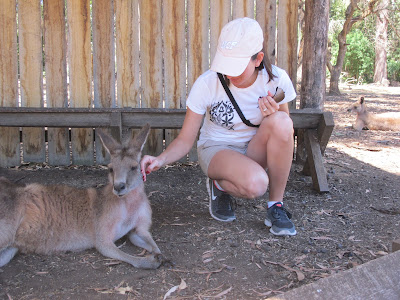
Sharon giving a 'roo a check scratch.


It's probably time this dude moved out of the pouch.

We ignored the collection of birds since we're not really bird people, washed our hands, and headed, finally, to Port Arthur.

Australia started out, at least for Europeans, as a penal colony. Britain decided it needed to shore up its presence in this part of the world and had a growing criminal population, so what better way to build infrastructure and harvest resources than with convict labor? Thus began the practice of shipping convicts to Australia. Britain's innocuous sounding name for this policy of involuntary emigration was "Transportation".

While many convicts sent here were hardened criminals, some were young boys who had simply been caught stealing bread. In Victorian times, you were considered in the eyes of the law to be fully accountable for your actions at the age of seven, and could even be put to death at the age of eight.

Until recently, the whole convict thing was a black mark on Australia and families were ashamed to have a convict in their ancestry. Now it's desirable to have one in the family history; it's the closest Australia has to royalty.

Port Arthur was by no means one of the earliest penal colonies in Australia; built in 1830, it came 42 years after the first one was established. It  was one of several sites created specially for the repeat offenders in Australia: after you were sent to some other penal settlement, if you still exhibited criminal habits you were then sent to places like Port Arthur.
View of the main dormitory for prisoners.

It was built as the latest experiment in criminal rehabilitation (a quest we're still pursuing to this day). In this model, which was in vogue in Britain, criminals would be organized into various groups based on their crimes and the type of labor they would perform. Skilled convicts, such as bakers, tailors, and blacksmiths, got better jobs than unskilled convicts. Petty criminals also got assigned better jobs than those who'd committed more serious crimes. The idea was that convicts would be rehabbed through physical work, and the system was structured to allow them to rise through the ranks, as it were, and get special privileges -- all with a goal of making them see that they could enjoy a good life if only they behaved and followed the law. In fact, many convicts were released and became pillars of their communities using skills they learned.

But this was without a doubt a hard place. One man had broke his clavicle working in the mill and the doctor decided his whole arm had to come off. The medical team allegedly cut through the shoulder with a whale-bone saw (with no anesthesic, of course) and then cauterized the opening with a red hot cooking pan. The man was put back on the workforce after three days.

In the 1850s a new model on the best way to straighten out criminals was exported from England to Tasmania. This model focused on keeping prisoners in solitary confinement. Only in this manner, prison reformers decided, could sinful men truly have the opportunity to reflect on their ways and find salvation in God and a path of righteousness.
View down the hallway in the Solitary Confinement building.

A new wing to implement this model was constructed. Men placed here were completely segregated from all human contact. This was done so thoroughly that even orders from guards were communicated using bells, not spoken. When these prisoners were allowed outside for their 1 hour a day of exercise, they had to wear hoods.

Really, as we know now, solitary confinement makes men crazy, and it wasn't long after this building came into existence that an insane asylum was erected next door.

Nowadays it's hard to believe this was a place of sorrow and hardship. The site is centered around a flat area next to a natural harbor. Gentle hills slope down to this point; on one side the sandstone ruins of the prisoner dormitories stand; on the other there are large houses (large for the day, anyways) with well-tended gardens that once housed the soldiers, reverend, doctor, and other free people who spent part of their careers at Port Arthur. The park staff have been working to recreate a large garden as it existed over 150 years ago.
View of the civilian grounds.

The doctor's house.

The old church, which was gutted by a fire.

Vandalism from 1933.

After wandering around for a while we decided we'd seen enough of the place. We left Port Arthur and drove back up the Tasman Peninsula and then southwest over to Hobart, the capital of Tasmania and its largest city. "Largest" doesn't necessarily mean "large", however. With a population of just 200,000 Hobart is still smaller than Wollongong, a satellite city of Sydney. But after driving through mostly empty landscapes, it seemed downright overbuilt.

We checked into a standard city hotel and were relieved to see other people staying there. It looked like we might just survive the trip. We got ourselves cleaned up and went out to explore the city. My initial take of a bustling city was mistaken: the streets were for the most part empty. We walked down the few blocks to the harbor, which was full of fishing boats, then headed over to the "hip" neighborhood, Salamanca, known for its Saturday market, restaurants, and bars. It's basically one street near the water with charming old buildings. We strolled along scoping out a bar to sit at and quickly ran out of sidewalk -- Salamanca isn't very big.
Hobart: this is as exciting as it gets.

We went to a James Squire pub and did flights of their beers (or paddles, as they called them, since the glasses came in short, modified paddles). Afterwards we went to Smolt for dinner; this was a restaurant recommended to us by some friends of friends in Sydney. We all splurged on a nice meal, but the overall impression was that it wasn't worth the money. We grabbed a drink afterwards and then crashed back at the hotel.


Sunday was our last day in Tasmania. We had planned on going to the top of Mt. Wellington, a mountain that casts its shadow over Hobart, and then continuing on to MONA, the Museum of Old & New Art. We'd been running ragged each day of the trip, though, and decided to end on a leisurely note, so ditched Mt. Wellington from the plan.

For brunch, our hotel recommended another hotel, the Henry Jones Art Hotel. This was a former jam factory that had since been turned into a cool art hotel that received several architecture and design awards. I had tried to book our stay in Hobart here but it was sold out. They had multiple restaurants in the complex and we picked one. The service was ridiculously slow. After only 16 hours or so, I was already bored with Hobart.

We then hopped in the car and drove to MONA, a museum opened in early 2011. MONA is exists thanks to David Walsh, a native of Hobart and college dropout who used his knowledge of mathematics to win millions of dollars gambling. Since earning his fortune, he's spent an estimated $100 million collecting various pieces of art and decided to erect a temple to hold it all, which, he confessed in an interview, had destroyed all of his wealth and actually put him in debt. It's an impressive structure from the outside: built into a hill, it overlooks the harbor and hosts its own winery, a number of restaurants, and several penthouses that can be rented out by guests.

To start your tour of the museum's works, you go down several levels after entering and then work your way up. None of the art is labeled. Instead, you are provided with what must be the coolest museum gadget ever: a modified iPod Touch with a custom app. With the touch of a button, it determines where you're located in the museum and displays the art in your vicinity. You just click on the ones you want to learn about.

Each work had four types of information. One button showed you the basics of who created the piece, and when, and using what materials. There was one called "Art Wank", which displayed the oftentimes obtuse description of the meaning of the art piece and why it was unique and how the artist thought it represented the world and all the fluff that normally just makes me roll my eyes, so I thought the button was titled appropriately; one called "Thoughts", which had random comments from the artist and the founder; and one that let you express your opinion.

This last option provided comic relief. If you liked something, it might say something like "74% of visitors shared your worldly good taste" and if you disliked something, it might say "3,820 other people were also simple-minded jerks".

As the name of the museum implies, there is both old and new art to be found. An Egyptian sarcophagus sits near a bloated Porsche called the "Fat Car"; Greek pottery is surrounded by modern paintings. One enormous work of art entitled "Snake" was in storage for 40 years and takes up the entire wall of a large room; Walsh's purchase of this piece was the impetus for building the museum since it required so much space.

There were several machines that actually replicate the process of creating human waste. As in #2. Yeah, machines that make #2. It reeked. Is that really art, I found myself wondering at several points. And that's exactly what Walsh wants: to be the anti-standard art museum; he wants to make people think and expects to offend. In one interview he even said he expected -- and hoped -- that people would deface some of the pieces. He has a secret apartment built into the museum, with a clear floor in spots so he can gaze into the largest room.
The poop machine.
Fat Porsche.
Something old...
The giant piece of art that was the impetus for the museum.

We exited with a couple of hours to kill before heading to the airport. At 33 degrees Celsius (about 92 Fahrenheit), this was one of the hottest days in Tasmania in recent history and made it too hot to wander around outside. We grabbed a table on the terrace of a very slick wine bar on site and ordered up some drinks and snacks.

Finally, it was time to head to the Hobart International Airport. This airport had 4 gates, and I suspect that's two more than they need. It was a tiny place, and I couldn't imagine having to spend much time there. Luckily, Sharon and I didn't. Unluckily, Alex and Michelle had about 4 hours to kill. We'd be home in Sydney before they even took off. Overall, it was a great trip and we had a lot of fun.

Next trip: the Kimberley region of Western Australia.

Monday, February 6, 2012

Tasmania in Four Days: Part 1


There are five states and two territories in Australia: New South Wales, Victoria, Northern Territory, Western Australia (not very original, it'd be like calling California "Western United States"), South Australia (again with the originality), Australian Capital Territory, which hosts the nation's capital (seriously, guys, come on), and Tasmania.

Among these, Tasmania -- or Tassie (pronounced Tazzy) as the locals call it -- is the runt of the litter. Literally, it's the smallest state by far.* Western Australia is nearly 1,000,000 square miles in area; Tasmania is about 26,000. Tasmania's situation isn't helped by the fact that it's an island of its own and you can only get there by plane or a 10 hour ferry. Most Australians have never visited. As a result, it always gets the shaft. When a big biscuit (biscuit=cookie) company launched a box of biscuits shaped like Australian states, Tasmania was left out. I have to admit, it doesn't feel like a part of the country.

Still, it's supposed to be a beautiful place and is known for its wines and cheeses. Sharon and I figured while we're in this remote corner of the world, we ought to check out Australia's remote corners, and this is one of them. We were joined by a couple friends: Michelle, a born-and-raised Aussie, and her husband, Alex, an American who now has Australian citizenship.

We flew directly from Sydney to Launceston, the second biggest city in Tasmania, which is located on the northern side of the island. The plane descended over turquoise blue waters  and pine tree-filled hills. Launceston airport is small, but nicely designed. We walked from the plane across the tarmac under a clear blue sky. The atmosphere was relaxed. "Now we're on Island Time," I declared to Sharon.

Typical Tasmanian landscape.

We took a quick spin through Launceston just to check it out (small, but charming) before a long haul to the east coast for our first destination, the Bay of Fires. The drive was spectacular. Every fifteen minutes someone would point out a particularly beautiful vista: "Look over there." Every time this happened I'd try to take a quick look as well, which usually coincided with the car briefly leaving the road. After an hour my passengers caught on and began saying "Look over there -- not you, Adam; you look at the road."

By 3:00PM the clouds rolled in and we still hadn't eaten anything since breakfast. The few restaurants we passed were closed for Australia Day. We passed a sign saying "Fruit Orchard + Golf: 800 meters" and, in need of a change of pace and some food, turned off the main road onto a gravelly track. The detailed sign soon gave way to lazier signs simply saying "Fruit Golf." We weren't sure whether we'd be teeing up some oranges or what, but soon passed a sad looking golf course before creeping up to a small shack next to a fruit orchard. We got hot chocolate and coffees and then hit the road again.

Just after our less than remarkable Fruit Golf experience, we discovered an old fishing boat moored to a dock that sold fish and chips. We were all famished by then so boarded for some lunch. The main highlight was a terrible aerial photo of said boat, which I christened the "Lunch Boat", hanging on the wall. The photo looked like it was taken in the 70s and, in addition to the boat, mostly captured the parking lot. Copies were on sale for $65. I wanted to ask the owner if anyone actually bought these but didn't want to offend him.

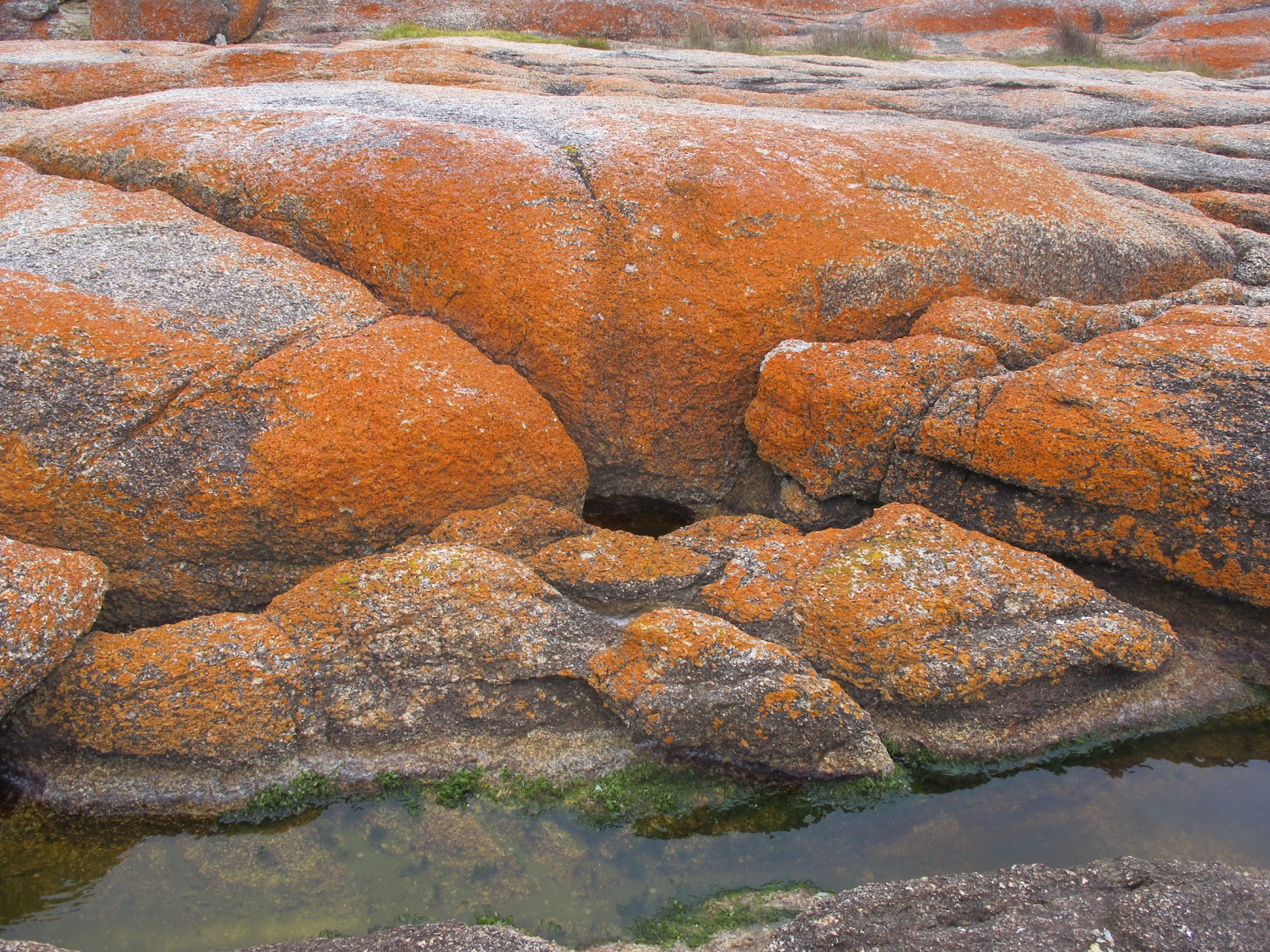
We once again got back on the road and 30 minutes later arrived at our first sightseeing destination. The Bay of Fires is a huge bay whose beaches are surrounded by giant red rocks; the red hue is caused by a bacteria and the bay earned its name because when the sun rises and shines off of the rocks, it looks like fire (well, as much as red rocks can look like fire). We, unfortunately, were not privy to this as the sun was tucked away behind a solid cloud cover.

Bay of Fires


As the rain threatened to intensify, we decided to move on. We sped down the Tasman Highway, which runs along the empty coastline and treats you to wonderful views of the Tasman Sea on the left and fields and hills on the right, and finally arrived in the tiny town of Bicheno, our stop for the night. There were only two restaurants in town and one of them was closed, so that forced us to go to the Sea Life Centre, an odd name considering it was just a plain old restaurant (albeit with lots of seafood on the menu) and a tacky gift shop.

Under peer pressure from Michelle and Alex, Sharon and I tried oysters for the first time. They were better than I expected and didn't have the rubbery texture that I thought all shellfish had. Despite being at the Sea Life Centre, for dinner I went with lamb.

Just as we were paying the bill our waitress asked, "Are you going to see the penguins now?"

"What penguins?" we asked.

Each night a number of mini-penguins comes on the rocks for a snooze. We walked down the hill to find a few hanging out. We couldn't take any photos because the flash disorients them.

A lazy evening in Bicheno.


Friday morning we woke up, got some breakfast sandwiches at Pork's  Place ("Where smiles are free.") and stopped by a blowhole. This was a cool formation of rocks that forced waves up through a crack; even with a light swell the water launched a good 15-20 feet in the air. I can only imagine how high it would get during a storm. Afterwards, we got on the road for a 45 minute drive to Wineglass Bay.
 
Bicheno's blowhole.

Wineglass Bay, along with Cradle Mountain, is among Tasmania's most famous spots. It's on a peninsula that breaks off from the Tasman Highway. We paid the fee for access to the park, changed into hiking clothes, and started our climb: to get to Wineglass Bay you first hike up a steep track to a lookout point, and then must walk down the other side to get to the bay. The hike up the near side is no disappointment, though. Huge boulders tower all around you and another flawless body of water, Coles Bay, sits at the bottom of the track.

Coles Bay

But once you get to the lookout -- that's where you realize everything you've seen yet pales in comparison. Wineglass Bay might be one of the most stunning beaches in the world. From the top of the trail looking down, turquoise water lapped against white sand that seemed to glow in the sunlight.  Huge green hills slope down to the shore. There wasn't a manmade structure in site. A few boats bobbed in the waves.

Excited by what awaited us, our step quickened on the walk down. At one point, we passed both a pregnant woman and a woman carrying a young child on their way back up. We were all sweating profusely supporting our own body weight; I couldn't imagine carrying another's. "Crazy," I thought.

View of Wineglass Bay from the lookout point.

At the bottom we changed into swimsuits. I dived into the water and just as quickly retreated back to the beach. Unfortunately, the tropical looking water doesn't have a tropical temperature. One Tassie woman had charitably called it "Refreshing." Someone of my disposition would call it "Freezing." There's nothing south of Tasmania except Antarctica, and that's where the ocean currents come from.

Then we clambered around on the huge rocks on the west side of the beach a bit before settling on to a blanket Sharon brought to relax for a while. We soon had a visitor. A wallaby had popped down from the brush to scope out the people. He just hung around a while, basking in the attention as everyone crawled closer and closer to get their photos. When he had enough, he bounded back up in to the dunes.
Wallaby checking out people on the beach.

We decided to go since we still wanted to visit a winery or two before the day was out, and we began the slow ascent back up the mountain to get back to the car park.

Before leaving Wineglass Bay, we wound our way up another hill -- this time in an air-conditioned car -- to a vantage point called Cape Tourville. From here you have an amazing view of the Freycinet Peninsula to the north and south. We took it all in for a moment, then got in the car again to head to some wineries.
 
View of Freycinet Peninsula from Cape Tourville; Wineglass Bay in the distance.

Along the way we stopped at a seafood stand and got some fresh lobster and oysters (and local beer) for a quick lunch. We followed that up with a stop at the Freycinet Vineyard (good wine; okay setting) and finished with a tasting at Milton Wineries. I didn't drink because I was driving, but this one definitely had the better setting to sit and enjoy some wines.
Fresh lobster and oysters.
At Milton Winery.

Thoroughly worn out, we headed towards our motel, the optimistically named East Coast Resort in Orford, which was a "one blink" town as described by a woman at the second winery.

Following the GPS' instructions, we pulled off the highway -- and I use that term loosely -- onto a local road with nothing around but some fields. We followed this road to the very end, where it terminated among a number of deserted lots sitting by the water. A few appeared to be warehouses. Another was a shuttered bar. An empty looking building had a banner hanging in front indicating it could be hired for conferences, but there was no other sign. 

"This can't be it, guys," I decided. "We're still a few kilometers from the town center." I started to drive back towards the highway. Alex called the hotel to find out where it was. It turned out the GPS was right: the empty building was in fact the lobby of the motel.

We turned around again and drove to the entrance. It didn't look any more occupied than before, but this time the front door was open. "You know this is how horror movies start, right?" someone said.

A guy inside sitting behind the desk checked us in. When we commented on the general lack of people he told us they were supposed to be shut down for renovations, but the work crew bailed before starting, and now they were trying to salvage their tourist season. He was going to head home but told us he was on call 24 hours a day if we needed anything.

We parked in the car lot -- we were the only car -- and walked to the second level, where we had rooms next to each other. No one else was staying at the motel.

"We can misbehave!" the girls cheered, skipping down the veranda.

We washed off the grime of our hiking and hopped in the car to head into the center of Orford, another tiny village that consisted of a liquor store, a gas station, a fish and chips place, and a pizza and pasta restaurant that had been recommended to us.

Alex and I sprung for the pizza special, made with wallaby salami. "Where did the wallaby come from?" I asked the waitress. "From the butcher in Bicheno," she replied. She didn't really answer what I wanted to know, which was "Is this roadkill or do they have wallaby farms here?" and I didn't press her on it.

(One side note on roadkill: a colleague who had been to Tasmania said it had more roadkill than he'd ever seen in his life; he was right about that. It seemed like every kilometer there was a dead wallaby, possum, or some other furry critter. "They're just sleeping," Alex assured us each time.)

Digging in to some wallaby salami pizza.

After dinner we headed back to the motel to drink some wine and play some cards. We huddled up in the room where Sharon and I were staying.  It was eerily quiet, and now that it was dark, a little scary.

"I hope we don't get murdered tonight," someone said.
"No one would hear if we were," someone else replied.
"Well, no one else is here."
"That just means one of us is the killer."

"What makes it all a bit alarming is that the phones don't work," said Alex. Sharon got up and picked up our room phone -- no signal. Sharon and I, both on Vodafone, the crappiest mobile network in the country, hadn't had a signal since arriving in Tasmania. Our phones said "No signal" but that implies there was a signal to be had; it should have said "Just forget about it". Alex and Michelle were on Optus and had been getting service at various spots in our travels. But here they also got nothing. So no mobile phones and no room phones. If anything did happen there was no way to reach anyone. It added to the horror film atmosphere.

Back in the States, Sharon and I often stayed in a small cottage in the mountains of Massachusetts, where no one else was around. Those experiences were never creepy -- it was solitude that we sought out to escape the buzz of New York. This was different. This was a forty room motel with only two rooms occupied. In the middle of nowhere. With no phones.

The fun was thoroughly sucked from the room. What had been a chance to misbehave was now a death trap. We decided to call it quits on the cards and go to bed. Paranoia got the better of me and I propped a chair against the bedroom door. I learned the next morning that Alex did the same thing.

The next morning we were excited to see everyone was still alive and the car wasn't sitting on cinder blocks. We quickly loaded everything up, checked out, and started the drive to Port Arthur, a penal colony during the 1800s. But you'll have to wait for Part 2 for that story.

*(I'm excluding the Australian Capital Territory here, which is comparable to Washington D.C. in purpose; i.e. I don't count it as a real state).
Some Tasmanian coastline...

Wednesday, February 1, 2012

No more LAFHA

One luxury to being an expat here in Australia is the ability to claim LAFHA every month. LAFHA is a government funded allowance for people living away from home. Basically, it helps subsidize your food and rent expenses thereby giving you more money in your paycheck. Since Adam works for a very large global consulting firm, he was unable to get this allowance (we were super bummed). However, once I got my new job for a much smaller company, I was able to obtain it with such ease. Within one paycheck cycle I noticed an increase in my salary which was not from my company.

It has been great benefiting from this for the last 11 months but to my sadness it has come to pass that as of July 2012,  this allowance will no longer be given to expats living in Australia without PR (permanent residency).  Many people on the same 457 Visa as myself claim they are eligible based on the fact that we normally reside overseas but are living in Australia for work. Just in the past year the amount of active 457 Visas in Australia doubled to 9,000. That means there are going to be 9,000 people just as unhappy as me.